
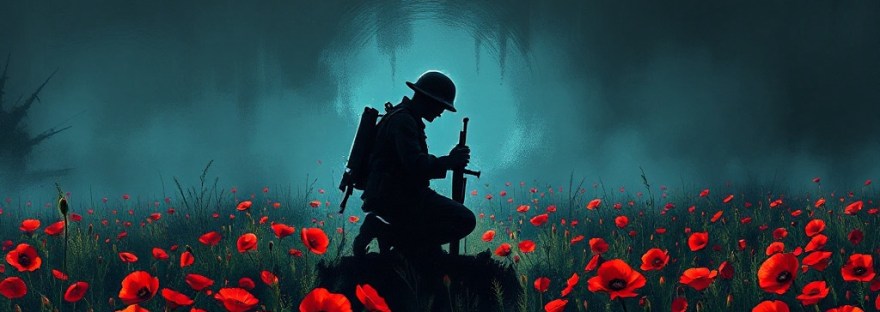
There is a stillness that settles over everything on Remembrance Day—a quiet that speaks louder than any words ever could. For two minutes, the world seems to hold its breath. The hum of everyday life pauses, and we are all suspended in time, together in our thoughts, yet each of us carries our own quiet reflection. There is a weight in the silence—a collective memory of sacrifice and loss. It is a silence that speaks to the bravery of soldiers but also to the lives left behind, the families who continue to carry their absence, often in ways unspoken.
As someone who has served, I know that this day is not only about honouring the men and women who fought on foreign soil but also the families who lived through the uncertainty and pain of waiting, worrying, and mourning. My grandfather was one of those men who answered the call. Like many others, he didn’t talk much about the war—what he saw, what he lost. And while I was still young when I knew him—perhaps too young to fully appreciate then, I could see it in the quiet moments when he’d sit at the table, staring off into space, lost in thoughts of a past too heavy to share.
I remember the silence at our dinner table during visits—no one spoke about what weighed on him. There was no need to, really. His service spoke for itself. But it was in those quiet moments that I understood that Remembrance Day is not just a day to honour the fallen. It’s a day to acknowledge the silence that exists between the past and the present, the unsaid grief, the invisible scars.
Those who served—and continue to serve—are often thought of as heroes. But another group carries a quieter, less visible form of sacrifice: the families left behind. We often speak of the bravery of servicemen and servicewomen in the field. But there is also bravery in those who wait at home, endure the uncertainty of deployment, and carry the burden of grief long after the uniforms are put away.
For every soldier who leaves, there is someone who remains—waiting for letters, phone calls, and a return that may never come. For every soldier who returns home, there is the silent recalibration of a family that has lived in a world without them. We, the ones who stay, may never fully understand the depth of the experiences our loved ones had in combat, but we, too, carry the weight of their absence. It is a quiet, often unacknowledged grief—a grief that is not just about the loss of a life but the loss of the future that could have been.
On Remembrance Day, we do more than remember the soldiers who fought. We recognize the weight of their sacrifice, the lives interrupted, and the families changed in ways they may never fully comprehend. But it’s also a day of connection—where, through silence, we find a shared understanding. The pause in time brings us together, even as we stand apart in our personal memories.
There is something universal in that stillness—a recognition that the past has shaped the present and will continue to shape the future. It’s in the quiet of the two-minute silence that we are reminded of the ongoing cost of war, not only in the loss of life but in the ripples that spread outward to affect generations. It’s a moment when we realize that memory, like grief, is a process that never truly ends. We remember, yes—but we also continue to feel the absence, the hole left in our hearts, families, and communities.
In the quiet, we acknowledge what words cannot convey: the unspoken grief of families who never stop missing their loved ones, the weight of living with the memory of their absence. It’s a silence that binds us, a silence that carries the full weight of their sacrifice, and in that silence, we find a way to remember—not just those who served but everyone they left behind.
When the silence lifts, we return to the world around us. But something stays with us: the quiet understanding that what we remember today is not just about the past. It’s about the present. It’s about recognizing the sacrifices made by so many and acknowledging the deep, lasting impact of those sacrifices on the families who carry their memory forward.
As we wear our poppies and stand in silence, we are reminded that remembrance is not only a solitary act. It is a shared moment of reflection, a chance for us to honour not just those who have served but those who still bear the weight of that service. And in that quiet, we find a space for healing—a space where we can honour the past while moving forward together in the present.

 The CJBuzz