
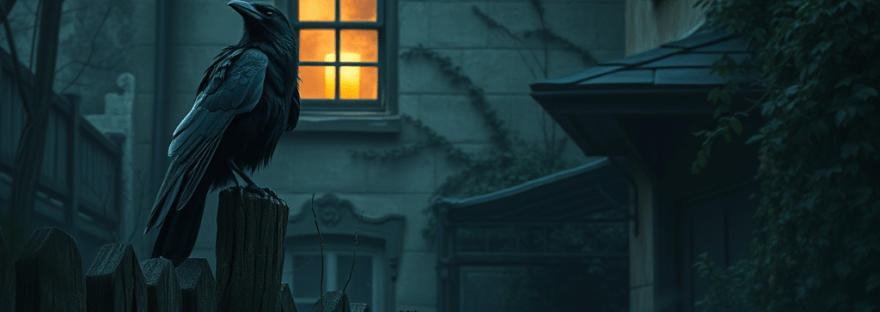
There’s a narrow street on the edge of town called Ashfield Road. Most people pass it without noticing. The road bends there, and the houses lean too close, their windows clouded and tired. The air smells faintly of chimney smoke and river mud.
I walk that way most evenings, though I couldn’t tell you why. Maybe it’s the quiet. Or maybe it’s the crow.
He’s always there—same place, same post—perched on the old fence beside the second house. A big bird, black as pitch, with one bent feather sticking out from its wing. He never calls, never moves much, just watches. If you walk close enough, you can see the fog of his breath in the cold.
The house he guards is empty now. The paint’s gone gray and the garden’s turned wild, choked with vines and dead stalks. I once asked around about who lived there, but no one seemed to remember clearly. “A woman,” they said. “She kept to herself.” Someone else thought she’d been a teacher. Another said she left one night and never came back.
Still, the crow stayed.
One evening in late October, I noticed something different. The fence post was bare. The crow was gone. Ashfield Road felt wrong without him—too open, too still. I kept walking, telling myself it didn’t matter. But just as I reached the end of the road, I heard it.
A soft tapping, like knuckles on glass.
I turned. The crow was at the window of the old house, pecking gently at the pane. The sound was steady, patient, almost rhythmic. Tap. Tap. Tap. I stood there watching, heart beating faster than it should have.
Then, through the dirty window, I saw the faintest glow—like candlelight moving through the rooms.
I didn’t stay to see more.
That night, I dreamt of Ashfield Road. The air smelled of wet wood and feathers. I was standing before the same window, only now the glass was gone, and the house breathed around me. Inside, the rooms were full of whispering—soft, fluttering voices that brushed against my ears and faded.
When I woke, the sound of tapping still echoed in my mind.
The next day, I walked by again. The house looked different—cleaner somehow, the vines pulled back, the window shining faintly in the morning light. And on the fence post sat the crow, head tilted toward me, that bent feather stirring in the wind.
Someone had tied a thin red ribbon around his leg. It fluttered when he shifted, catching the sun for a moment before going dull again.
I passed him slowly. He didn’t move, didn’t blink.
By the time I turned back, the ribbon was gone.
That night, I dreamed again. The same window, the same glow. Only this time, a woman stood beside the crow, her hand resting gently on his wing. She looked at me once—kind, tired, and almost grateful—before turning toward the candlelight.
When I woke, I could still smell smoke.
And outside my own window, resting on the sill, was a single black feather with one bent tip.

 The CJBuzz