
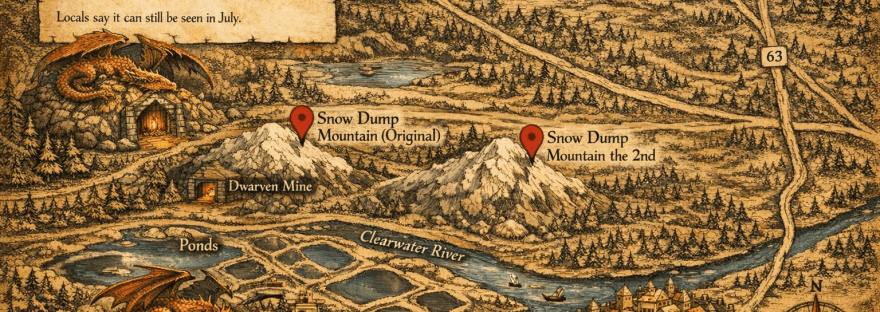
In the far North of Alberta, beyond the last sure reckonings of road and river, there lies a land seldom spoken of in tale or tally. No crown was ever set there, nor banner raised, and the wise pass it by without remark. Yet even in such places, where little heed is given, there are stirrings that escape the notice of most—and endure.
For in those wide and wind-worn reaches, where winter holds long dominion and the year is measured more by frost than by sun, there came to be two hills.
They were not wrought in the elder days, nor shaped by the deep workings of the earth. No fire of the world’s beginning raised them, nor did the slow patience of stone give them form. Rather, they were gathered—piece by piece, burden by burden—out of the labours of Men, who, contending with the unyielding season, cast aside what they could not keep.
Thus, the first hill arose.
It stood alone for many a year, pale and unadorned, and few there were who marked it, save those whose tasks led them near. It had no name of worth, for none thought it deserving of one; and so it lingered, a quiet thing beneath the passing sky.
But the winters in that land are not easily spent, and they do not forget.
Year upon year, they came, laying their white weight upon field and way, until again the burden was gathered and borne away to that same place. And the hill grew.
At first, none marked the change. What is a little more, in a land already burdened by much? But the little did not remain little. The heap rose higher, and what was meant to vanish began, in its own quiet way, to remain.
And there are some who say—though never loudly—that Men, seeing this, did not turn away. For there is in the hearts of Men a strange leaning: to add to a thing already too great, if only because it is there.
And so they brought more.
Not elsewhere. Not apart. But again to that same ground. As though the first hill, having grown beyond its place, called for an answer.
And so it was that a second hill was made beside it.
Snow Dump Mountain the 2nd, it was called—though the name was given lightly, and with little care. Yet names, even those spoken in jest, have a way of abiding; and in time it clung to that place as frost clings to branch and stone.
Some have said that the first hill grew great in its solitude, and that a second was raised to humble it. Others hold that no such thought stirred in the hearts of those who made it, and that it was only the long habit of winter, and the weariness of those who must answer it, that brought the second into being.
Yet there are a few who wonder if something else took root in that making—something quieter, and less easily named. For the second did not merely answer the first.
It completed it.
Whatever the truth, the two now stand together.
Side by side, they endure the long cold and the brief thaw alike. In winter, they rise stark and unyielding beneath a dim sky; in summer, they sink and soften, yet do not wholly pass away. Long after the snows have fled from field and forest, they remain—lingering, as though unwilling to depart.
Few give them more than a passing glance. To most, they are but remnants, the leavings of a season best forgotten.
And yet, there are some who, pausing upon the road, feel a strange unease—or else a wonder they cannot name. For though these hills were not shaped by the ancient powers, nor sung into being in the dawn of days, still they abide.
And in their abiding, they gather something more than snow.
A memory, perhaps. Or the first faint echo of a tale not yet told.
For even the smallest and most unlikely of places may, in time, become the seed of legend.

 The CJBuzz