
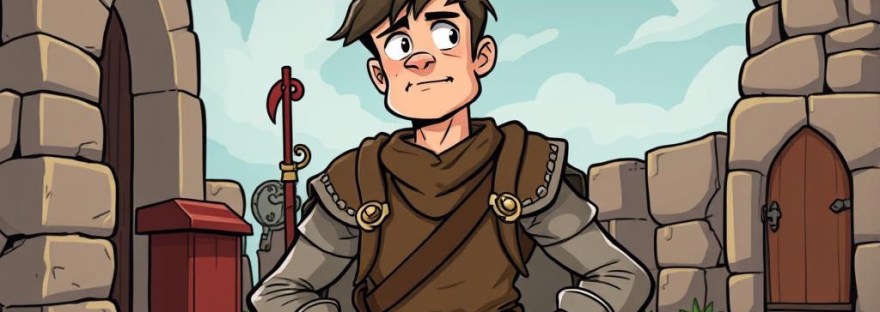
He sat down to write a story about a hero.
Not a big hero. Not the kind with a glowing sword or a past you have to squint through. Just a regular one. You know the type. A man who woke up one day and decided to do something difficult and good. A man who wanted to change the world for the better!
That was the plan.
He wrote the first line:
The hero stood at the edge of town, ready to begin.
And then he stopped.
Because the edge of town didn’t make sense.
Towns don’t just end. Not cleanly. There are roads. Fences. Someone owns the land past the last house. There’s probably a sign about dumping fines, leaning a bit because no one’s fixed it in years.
So he crossed out the line.
He tried again.
The hero stood at the municipal boundary, having filled out the required travel forms…
Nope. That’s worse. He leaned back and rubbed his face like that might reset something.
The hero, meanwhile, remained nowhere.
—
He tried to simplify. Just let the man leave. People leave places all the time.
So he wrote:
The hero left town at daybreak.
And immediately thought….money.
Heroes don’t eat courage. They eat food. Food costs money. Even if he packed supplies, where did they come from? Does he have a job? Did he quit? Did he give notice?
He stared at the sentence until it felt like it was staring right back at him.
Then he added:
He checked his coin pouch.
Fine. That seems practical enough…
He paused again.
How much?
Too little, and the journey ends in three days. Too much, and now he’s a man carrying enough to get robbed, taxed, or noticed.
And once someone notices you, they ask things.
Who are you? Where are you going? Do you have papers?
He scratched at his beard and muttered something he didn’t finish.
The hero, still at daybreak, still leaving, began to look less like a hero and more like a man making poor financial decisions.
—
He stood up, went to the kitchen, and stared into the fridge.
It offered a jar of mayonnaise and a carton of eggs that had passed their prime, but not quite their usefulness.
He closed it and went back.
Fine. Forget the money.
He sat down, took a breath, and wrote:
The hero walked the open road.
Simple. Good.
Then he frowned.
Open roads aren’t unclaimed. Someone built it. Someone maintains it. There are tolls. Patrols. If things are unstable, checkpoints.
And if there are checkpoints, there are guards.
And guards don’t just wave through strangers who say, “Don’t worry about it. I’m on a quest.”
He tapped the desk, slow and uneven.
The hero reached the first checkpoint and was asked for identification he did not have.
The hero was turned around.
The hero went home.
—
He deleted the last paragraph.
Then the one before that…
And then the one before that, until the page was mostly empty again. Was this better or worse?
He looked at the flashing cursor. It looked patient. That annoyed him.
“Just go,” he said, to no one.
He typed:
The hero didn’t tell anyone. He just left.
Yeah! That felt right.
Quiet.
He sat with it… then sighed.
Because leaving without telling anyone isn’t simple either. It’s loose ends. People waking up and realizing you’re gone. Questions. Maybe someone coming after you—not to stop the quest, but to drag you back.
Responsibility is a hard thing to step over.
He rested his forehead on the desk.
The wood was cool. That helped.
—
The hero still hadn’t made it out of town.
The writer hadn’t made it past a paragraph.
They were, in a quiet and slightly embarrassing way, in the same place.
Stuck at the beginning.
—
He sat up again, slower this time.
Maybe the problem wasn’t the world. Maybe it was that he kept trying to make it behave. Make it fair. Make it sensible. Make it run like a system that couldn’t be ignored.
But people ignore systems all the time.
They slip through. Get lucky. Get waved past because someone is tired, or distracted, or just doesn’t care enough to stop them.
Things don’t always line up. Sometimes you just go.
He looked at the page again.
Took a breath.
And wrote:
The hero left anyway.
He stopped there. Didn’t explain it. Didn’t justify it. Didn’t add a coin pouch or a man at a gate asking questions.
Just that.
Left anyway.
—
It wasn’t perfect.
It didn’t solve the economy. Or the politics. Or the long list of reasons a person might stay where they are and never try anything at all.
But it was something that moved. The hero, finally, was no longer standing still.
The writer leaned back and let that be enough for now.
Which, for him, was a small and quiet kind of progress.
And maybe, if he didn’t think about it too much, he could follow.

 The CJBuzz