
The grocery store is a remarkable place.
At first glance, it appears ordinary. Bright lights. Fresh bread. A shopping cart with one wheel that sounds like it’s losing an argument. But spend enough time here, and you’ll discover an ecosystem unlike any other.
Join me as we venture deep into this vibrant and mysterious world where every aisle is home to a variety of species. And while some are common, others are rarely seen outside of their natural habitats. Researchers have spent years studying this unique environment, though many questions remain unanswered.
Today, we observe from a respectful distance.
The Aisle Blocker is one of the easiest species to identify.
Notice how they gently turn the shopping cart sideways before coming to a complete stop. This isn’t carelessness. It’s instinct. Researchers believe the Aisle Blocker possesses an uncanny ability to locate the narrowest possible section of the aisle before settling in to compare two nearly identical jars of pasta sauce.
The differences are subtle: ingredients, sodium, price, perhaps even the font on the label. To the rest of us, they’re the same jar. The Aisle Blocker knows better.
The growing line of shoppers behind them goes completely unnoticed because they are focused entirely on the hunt. Eventually, after several minutes of careful consideration, a decision is reached.
Neither jar is selected.
The search continues elsewhere.
Interestingly, every other species in the store believes the Aisle Blocker is the one slowing everyone down. Researchers have confirmed they all believe exactly the same thing about each other.
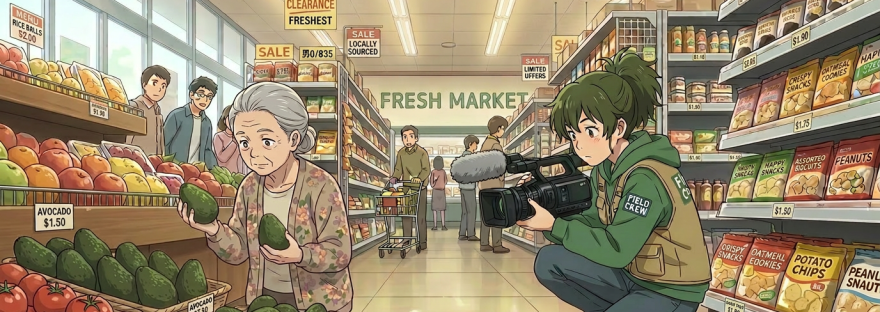
The Produce Inspector is a patient creature.
There is no rush. There never has been.
An avocado is lifted from the display with remarkable care, turned slowly in the hand, and given a thoughtful squeeze. It doesn’t pass inspection. Neither does the next one. Or the one after that.
To the casual observer, every avocado appears identical. The Produce Inspector disagrees.
Somewhere in this pile lies the perfect avocado, and they are prepared to inspect every single one until it is found. Researchers estimate this ritual has remained largely unchanged for generations.
Occasionally, the Produce Inspector can be seen nodding ever so slightly before placing one avocado into the cart. We still don’t know what they felt that the rest of us missed.
Near the front of the store, we encounter the Cart Abandoner.
Having completed its mission, the shopping cart is quietly left beside a display of barbecue sauce.
Why?
We simply don’t know.
Many believe the Cart Abandoner intends to return after grabbing one final item. There is little evidence to support this theory. Instead, the cart becomes part of the landscape, where it waits patiently for an employee or another unsuspecting shopper to relocate it.
Researchers have observed this behaviour for decades. No one has ever documented the Cart Abandoner returning for the cart.
The List Wanderer enters the store with confidence.
There is purpose. Direction. Perhaps even optimism.
Then the shopping list appears.
Everything changes.
Notice the slow turn in the cereal aisle. The thoughtful pause beside the frozen vegetables. The unexpected return to the cereal aisle moments later.
Researchers believe the List Wanderer briefly forgets that grocery stores have signs hanging from the ceiling. After several minutes of quiet wandering, they eventually ask an employee where the flour is.
The flour has been behind them the entire time.
Despite years of observation, researchers have never successfully explained why the List Wanderer and the Aisle Blocker almost always encounter one another in the narrowest aisle of the store.
The Sample Hunter is remarkably difficult to surprise.
Exactly how this species detects free food remains a mystery, though experts suspect they can hear a cube of cheese being placed into a paper cup from nearly three aisles away.
Notice how they approach casually. Relaxed. Unconcerned. As though they were already heading in this direction.
They weren’t.
Some will linger nearby after receiving their sample, suddenly developing a deep interest in products they have ignored for the last twenty years. Others simply continue circling the display, quietly confident that another tray is about to appear.
Researchers have attempted this behaviour themselves. Most become self-conscious after the second lap.
Perhaps the busiest creature in the entire store is the Parent of a Toddler.
At first glance, they appear exhausted. This observation is almost always correct.
Despite surviving on coffee that has gone cold at least twice, this species possesses remarkable awareness. Despite their struggles, they are shopping, steering a cart, answering seventeen unrelated questions, locating crackers, apologizing to strangers, negotiating with a tiny hostage-taker over the importance of wearing shoes, and somehow still remembering they came for laundry detergent.
Notice the speed with which they retrieve a stuffed dinosaur before it touches the floor. The calm explanation for why bananas can’t be opened before they’ve been paid for. The effortless catch of a juice box launched for reasons science has yet to explain.
To the casual observer, it appears chaotic.
In reality, this is years of adaptation.
Against overwhelming odds…
They still remember the milk.
Researchers continue to regard this as one of the more impressive survival strategies found anywhere in the wild.
In another section of the store, the Self-Checkout Philosopher believes the journey is nearly complete.
The final item is scanned. Victory is within reach.
Then, without warning…
“Unexpected item in bagging area.”
The Philosopher freezes.
They look at the screen.
Then the bag.
Then back to the screen.
Researchers have yet to determine what the unexpected item actually is. The Philosopher certainly doesn’t know. Unless the machine has suddenly developed strong opinions about bananas, there appears to be no explanation.
Neither side is willing to admit defeat. The standoff continues until an employee makes the familiar walk across the store to restore peace to the ecosystem.
Balance has been restored.
For now.
Before we leave, there is one final species worth mentioning.
The Quiet Cashier.
Often overlooked, they have already greeted hundreds of shoppers today. They’ve answered the same questions, heard the same joke about an item that “must be free” if it won’t scan, and somehow know exactly where the peanut butter was moved last week despite having no say in the matter.
Notice how they remember the regulars. They ask about grandchildren. They compliment a child’s dinosaur shirt. They patiently explain, for what may be the seventh time today, that no, they don’t control the price of butter.
Most shoppers pass by without giving them much thought.
Researchers agree on this one.
The ecosystem would fall apart without them.
The grocery store has always looked ordinary.
It isn’t.
It’s a place where hundreds of tiny stories unfold every day. Strange little rituals that somehow make perfect sense to the people performing them. Spend enough time watching, and you’ll realize we’re all somebody else’s wildlife.
As we prepare to leave, one final observer catches the eye.
Standing quietly near the cereal aisle, they appear to be comparing two boxes they have no intention of buying.
They’re simply watching.
Taking notes.
Studying the habits of the local wildlife.
Curiously…
They seem to be smiling.


